



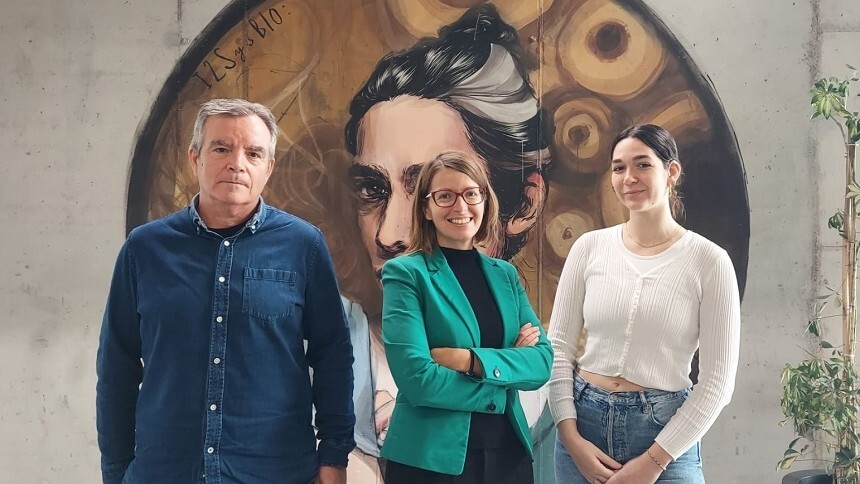
Research staff of the Institute of Integrative Systems Biology (I2SysBio), located in the University of Valencia Science Park and joint center of the University of Valencia (UV) and the Higher Council for Scientific Research (CSIC), has developed CleanBar, a bioinformatics tool to analyse the DNA sequences of complex samples from the perspective of individual cells
The work directed by Maria Dzunkova, researcher at the Institute of Integrative Systems Biology (I2SysBio), located in the scientific-academic area of the University of Valencia Science Park (PCUV) and published in the journal ISME Communications, focuses on observing how phages (bacterial viruses, often used to combat multi-resistant pathogenic bacteria), multiply within each bacterial cell and reveals that infections are not uniform in all cells.
"Applied to the study of virus infections, it offers a direct window to observe how they spread in each cell, how many copies they produce and how the infection varies between different bacteria in the same population," explains Vicente Arnau, programmer of the application, I2SysBio researcher and professor in the UV Informatics Department.
Single-cell sequencing is a technology that allows the analysis of the genetic material of individual cells, in contrast to traditional sequencing that analyzes an average number of cells from one tissue or sample. This technique allows us to unravel cell heterogeneity, identify complex cell types and understand subtle differences between cells. CleanBar is an open source application, easy to install and that allows you to analyze sequencing files of varying sizes, from thousands to millions of sequences, in a reduced time.
"Applied to the study of virus infections, CleanBar offers a direct window to observe how they spread in each cell, how many copies they produce and how the infection varies between different bacteria in the same population.", Vicente Arnau, application programmer and I2SysBio researcher
Applied to microbial sequencing, single cell sequencing provides the genetic code of individual bacteria present in a sample and information on bacterial interactions with plasmids and bacteriophages. Technically, the process of identifying each cell (or bacteria) is achieved by adding a unique DNA tag to the cell.
There are several technologies, but the one that is most accessible in any laboratory is the technique called spint-and-pool barcoding (labelled by division and mixture), recently developed by the Lithuanian biotechnology company Atrandi Biosciences. In this type of labelling a set of 4 different sequences or labels is added on the laboratory bench using a 96-well plate, without having to buy any expensive equipment, which will allow to differentiate the DNA coming from each of them. These labels are called barcodes.
"We will then have to separate and group the DNA sequences by their barcodes and thus obtain the sequenced DNA of each individual cell. In this work we have collaborated researchers from 3 different groups of I2SysBio, where we show our software CleanBar, a tool to separate the DNA sequences obtained according to the barcodes used to identify each of the bacteria in a sample", explains Vicente Arnau, who adds that CleanBar is also able to detect the barcodes in variable positions, with separations between them different than expected and can also predict wrong classifications, where one or two of the barcodes fail.
This project is funded by the Generalitat Valenciana (GV) Gen-T programme, the Investigo (GV) programme and the Spanish Ministry of Science, Innovation and Universities.
Do not miss the interview with Maria Dzunkova in our section Nosaltres eSTEM
Source: UV News
Vicente Arnau, Alicia Ortiz-Maiques, Juan Valero-Tebar, Lucas Mora-Quilis, Vaida Kurmauskaite, Lorea Campos Dopazo, Pilar Domingo-Calap, Mária Džunková, CleanBar: a versatile demultiplexing tool for split-and-pool barcoding in single-cell omics, ISME Communications, Volume 5, Issue 1, January 2025, ycaf134, https://doi.org/10.1093/ismeco/ycaf134
--
Recent Posts