



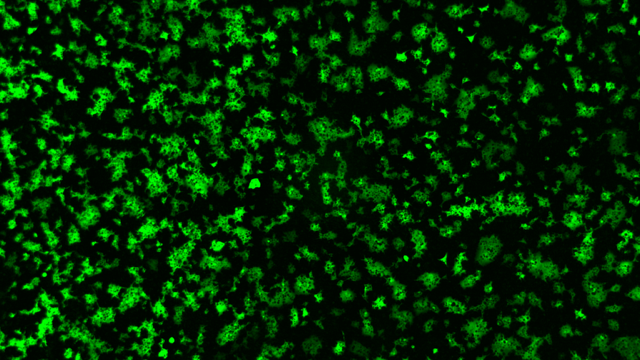
The Institute of Integrative Systems Biology (I2SysBio), located in the University of Valencia Science Park, is co-leading a study that reveals the infection mechanism of a pig virus related to those that cause common colds in humans. The results, published in Nature Microbiology, provide information on the evolution of coronavirus and its entry into cells, key data to anticipate and prevent pandemics
An international team led by the Institute of Integrative Systems Biology (I2SysBio), joint centre of the Higher Council for Scientific Research (CSIC) and the University of Valencia (UV) located in the business area of the University of Valencia Science Park (PCUV); and the Institut Pasteur in Paris, has identified for the first time a functional receptor for the swine hemagglutinous encephalomyelitis virus, also called porcine coronavirus PHEV. This virus is related to others that cause common colds in humans. The results, published in the journal Nature Microbiology, represent a key step forward in understanding the mechanisms of entry of these pathogens, as well as to understand how coronaviruses like the one that caused COVID-19 evolve.
The porcine coronavirus PHEV belongs to the embecovirus, a subgroup that includes human, bovine and porcine viruses within the large family of coronaviruses where SARS-CoV-2 is found which triggered the recent global epidemic. It is closely related to two human viruses that cause common colds: OC43 and HKU1. Although it was thought that these viruses depended on sugars such as sialic acid to enter their target cells and infect the host organism, the new study shows that the porcine coronavirus PHEV can enter cells without the need for them. It uses a protein known as DPEP1, which is found in the cell membrane, as a receptor to facilitate its entry.
"The protein spike zone that allows the porcine coronavirus PHEV to bind to the DPEP1 receptor is highly variable and does not appear in the spikes of other similar coronaviruses, such as human coronavirus OC43. This suggests that the use of DPEP1 as a receptor is peculiar to porcine coronavirus PHEV, and that other viruses in the same family use different receptors that have not yet been identified", Jérémy Dufloo, researcher at I2SysBio and lead author of the article
Using advanced electron microscopy and X-ray crystallography techniques, researchers have visualized how the virus’s spike protein, the 'key' used by coronavirus such as SARS-CoV-2 to enter our cells and initiate infection, binds to this DPEP1 protein. This analysis made it possible to understand precisely the molecular fit between both proteins, revealing that the region of binding of the virus is highly variable, which suggests a great capacity for evolutionary adaptation.
Antivirals and the possibility of human transmission
"The spike protein zone that allows the porcine coronavirus PHEV to bind to the DPEP1 receptor is very variable and does not appear in the spikes of other similar coronaviruses, such as human coronavirus OC43," explains Jérémy Dufloo, researcher at I2SysBio and lead author of the article. "This suggests that the use of DPEP1 as a receptor is peculiar to the porcine coronavirus PHEV, and that other viruses in the same family use different receptors that have not yet been identified," he adds.
The study also shows that the interaction between porcine coronavirus PHEV and the protein DPEP1 can be blocked by applying this protein in soluble form, which opens the door to the development of viral entry inhibitors as an antiviral strategy. In addition, the experiments confirm that the human version of DPEP1 also allows the entry of the PHEV coronavirus into cells, raising questions about the ability to transmit this porcine virus from animals to humans.
Prevention of future pandemics
This work not only identifies a new viral receptor, but also provides key information on the evolution of coronaviruses and their entry mechanisms, which are fundamental aspects for anticipating and preventing future pandemics.
From the point of view of scientific implications, the finding opens up new lines of research. As explained by Rafael Sanjuán, principal investigator of I2SysBio and author of the article: "On the one hand, it will allow to study in more detail the role of DPEP1 in PHEV infection in vivo. It also provides a basis for developing drugs or antibodies capable of blocking the interaction between the virus and this receptor, which could lead to new antiviral treatments".
"The research will allow further study of the role of DPEP1 in PHEV infection in vivo. In addition, it provides a basis for developing drugs or antibodies capable of blocking the interaction between the virus and this receptor, which could lead to new antiviral treatments", Rafael Sanjuán, principal investigator of I2SysBio and author of the article
In addition, the researcher from the Valencian center believes that this discovery poses a new challenge: "to identify receptors using other PHEV-related coronaviruses, which are still unknown," he concludes.
Source: Delegation CSIC Comunitat Valenciana
Dufloo, J., Fernández, I., Arbabian, A., Haouz, A., Temperton, N., Gimenez-Lirola, L.G., Rey, F.A, Sanjuán, R., Dipeptidase 1 is a functional receptor for a porcine coronavirus. Nature Microbiology (2025) https://doi.org/10.1038/s41564-025-02111-7
--
Recent Posts