



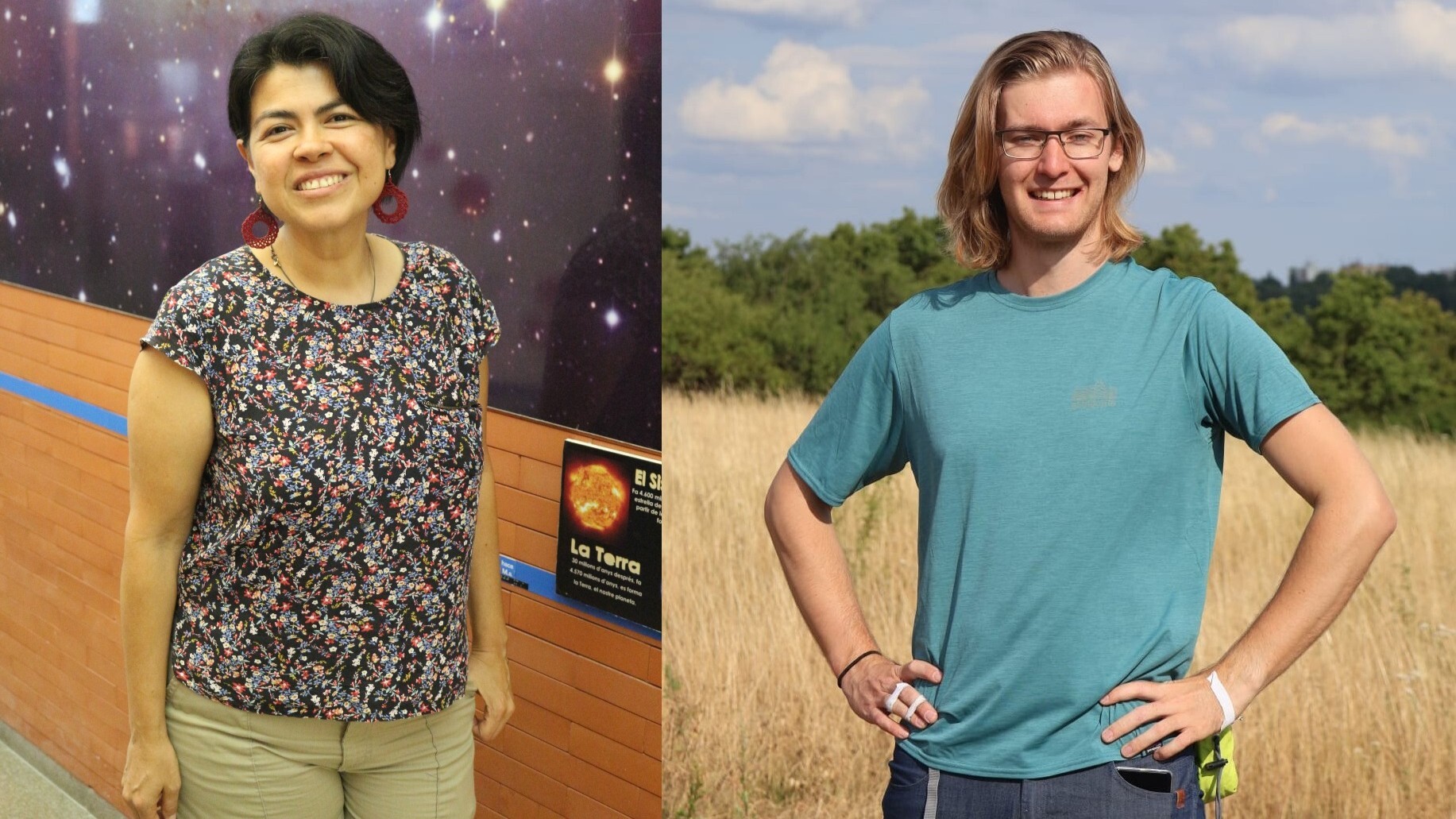
Two theses developed at the Institute of Corpuscular Physics (IFIC), a research center of the University of Valencia Science Park (PCUV), have received the Extraordinary Doctorate Prize in Physics, an award awarded annually by the University of Valencia. On this occasion, the authors of the winning theses were Fabian Esser and Norma Selomit Ramirez
First, Fabian Esser’s thesis, entitled Exploring UV completions of the Standard Model with Effective Field Theories, was led by three scientists and scientists from the Institute of Corpuscular Physics (IFIC), located in the scientific-academic area of the University of Valencia Science Park (PCUV): Verónica Sanz González, Professor of Theoretical Physics at the Universitat de València, and CSIC researchers Martin Hirsch and Andrea Donini.
This work addresses the search for possible ultraviolet theories to complete the Standard Model of particle physics. «I like to compare the new physics in high energies with a mountain whose top we may not see and relate the search for that physics with possible methods of climbing the mountain. We could find a nice hiking trail, but maybe the walls themselves need to be climbed,» explains Esser. In this sense, a useful tool in indirect searches are the Effective Theories, which assume that the scale of the new physics is high compared to the typical moment of the processes under consideration.
In the first part of the thesis, all models that can generate a specific subset of operators from the Effective Field Theory of the Standard Model (SMEFT) are searched and classified under well-specified assumptions. Those models with vector fermions and heavy scalars for operators with four fermions (4F) in dimension-6 or Triple Gauge Neutral Couplings (NTGCs) give rise to an interesting phenomenology in colliders.
"I like to compare the new physics in high energies with a mountain whose top we may not see and relate the search for that physics with possible methods to climb the mountain. We could find a nice hiking trail, but maybe you need to climb the walls themselves", IFIC researcher Fabian Esser
An Axion-type particle (ALPs) generically refers to a pseudo-scalar Goldstone boson arising from the spontaneous rupture of a global symmetry, for example, from new contiguous sectors. Assuming that the energy scale associated with this symmetry break is high compared to the electroweak scale, this motivates an EFT approach to describe the interactions of ALPs with Standard Model particles.
In the second part of the thesis direct and indirect probes are used in colliders to establish boundaries in the couplings between ALPs and SM particles, especially top quarks.
Norma Selomit Ramirez' thesis, entitled From a causal representation of multiloop scattering amplitudes to quantum computing in the Loop-Tree Duality, was directed by Germán Rodrigo, CSIC researcher at IFIC; German Sborlini, professor and researcher at the University of Salamanca, and Roger Hernández, professor and researcher at the Autonomous University of Sinaloa (Mexico).
Selomit Ramirez’s thesis aims to face the current challenges in the search for greater precision in theoretical predictions in high-energy physics. This is the case of multiple-loop scattering amplitudes, which describe quantum fluctuations in high energy scattering processes
Selomit Ramirez’s thesis aims to meet the current challenges in the search for greater precision in theoretical predictions in high-energy physics. This is the case of multi-loop scattering amplitudes, which describe quantum fluctuations in high-energy scattering processes. The Loop-Tree Duality (LTD) is an innovative method, proposed with the objective of addressing the difficulties implied in the management of amplitudes with multiple loops.
In this thesis we present the reformulation of Loop-Tree Duality, a general methodology to obtain expressions of amplitudes with a behavior manifestly free from non-causal (non-physical) singularities, as well as the first application of a quantum algorithm in Quantum Field Theory. The resulting LTD representation follows a factored structure in terms of simpler subtopologies, characterized by well-known causal behaviour. Furthermore, analytical dual representations are obtained that are explicitly free of non-causal singularities, thus achieving better numerical stability compared to other representations. Finally, the connection between the Feynman loop integrals and quantum computation is established, proposing a modification of the Grover quantum algorithm to find the singular causal configurations of the Feynman diagrams with multiple loops.
About the winners
Fabian Esser (Leverkusen, Germany, 1995) studied physics at the RWTH in Aachen, Germany, and master’s degree in theoretical physics at Aachen and the Institute of Theoretical Physics (UAM/CSIC), Madrid. In 2020 he started his PhD thanks to a pre-doctoral contract Santiago Grisolía of the Generalitat Valenciana and did internships at Cambridge and UC Berkeley. Since October 2024, Fabian has been doing his first post-doctoral work at Charles University, Prague, Czech Republic, and continues to explore physics beyond the Standard Model, for example in double beta neutrino-free decays and Grand Unification Theories.
Norma Selomit Ramírez Uribe (Culiacán, Mexico, 1982) holds a degree in mathematics from the Autonomous University of Sinaloa (UAS, Mexico), and a master’s degree in probability and statistics from the Centre for Research in Mathematics (CIMAT, Mexico). Before starting his PhD, he worked in private industry as a project leader in the area of credit risk. He was also a lecturer at the Faculty of Earth and Space Sciences and the Faculty of Physical-Mathematical Sciences at UAS. During this time, she became involved in issues related to the calculation of multiloop scattering amplitudes, an experience that motivated her to continue her PhD studies in physics.
Currently, Selomit Ramirez works at the Autonomous University of Sinaloa as a professor and researcher. She also acts as a delegate for the state of Sinaloa in the Mexican Mathematics Olympiad. On the other hand, it also continues to collaborate with IFIC’s LHCPHENO theoretical group on issues related to LTD and applications of quantum algorithms.
Source: IFIC
Recent Posts